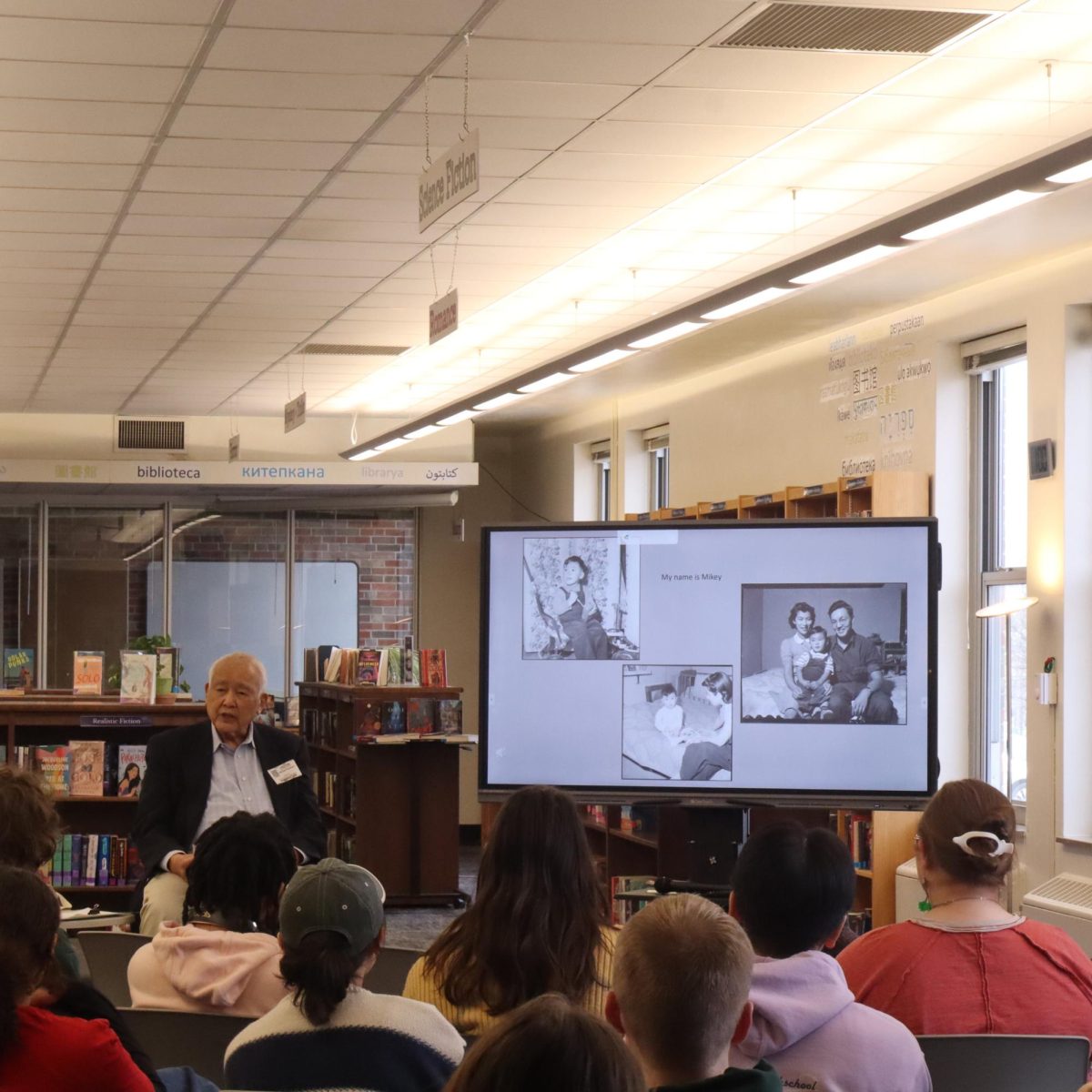
For most 3-year-olds in the United States, life is simple. But, for Mikey, an executive order shifted his burdens from play-dates and preschool to packing up all that he could carry to move to an unknown location.
“I want to bring my teddy bears. Mommy says we don’t have room. I have six teddy bears. I want to bring all of them. Mommy finally says I can bring just one,” Michael Hosokawa said, from the perspective of his 3-year-old self.
Hosokawa came to Hickman High School to speak about his experience getting sent to an internment camp during World War II in a presentation called “Looking Like the Enemy.” He joined the 125,000 other Japanese Americans — 75% of which were born in the United States — sent to internment camps by former President Franklin D. Roosevelt’s Executive Order 9066.
(Tessa Johnson)
The event was planned and coordinated by Zach Rodeman, an Advanced Placement United States History (APUSH) teacher at Hickman. He came across Hosakawa’s story through email then reached out to invite him to speak.
“My class had wrapped up their unit that included World War II last week, so I kind of planned it around that,” Rodeman said. “It’s a way to have living history where people can interact with each other… To try to get the students to see beyond the notes, or beyond ‘I’ve got to remember this date for a test.’”
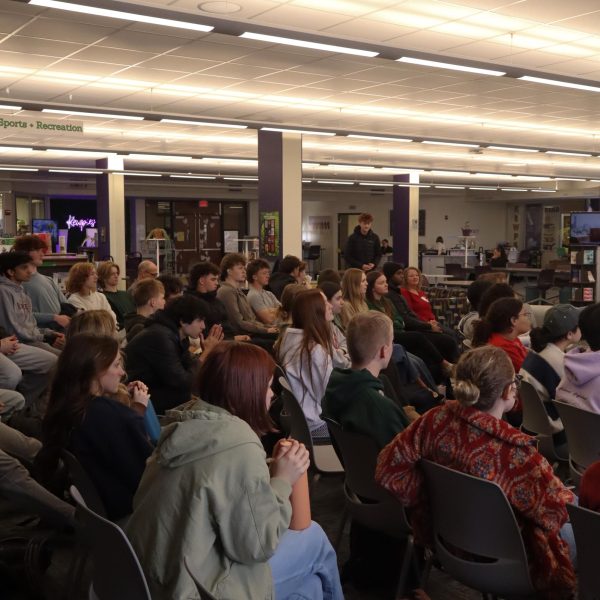
Around 100 students got to see Hosokawa’s presentation. Oliver (Ollie) Hoyt is a junior currently taking APUSH, and he appreciated learning about the internment camps beyond a textbook.
“It’s very different to hear the personal experience and how [the camps] actually affected real people. Because I feel like you don’t really get that very much in history… It definitely gives me a lot more sympathy,” he said.
Hosokawa and his family were placed in an old animal shed for a couple of months before riding a train to Heart Mountain, Wyoming. He recalled a conversation between him and his mom when they arrived.
“Mommy, I don’t want to live here. It’s stinky and dirty. I want to go to my real home,” Hosokawa said.
The internment camps were created in the midst of wartime hysteria and racial prejudice following Japan’s attack on Pearl Harbor. While marketed as a form of protection, the discrimination behind the executive order quickly revealed itself.
“I think both sides began to see each other as we’re all human beings, and so the relationship with the soldiers became very friendly, and I think they all wondered why they were there,” Osokawa said.
A common saying in Rodeman’s APUSH class is that “history doesn’t repeat, it rhymes,” and Hosokawa warns that the modern day Immigration and Customs Enforcement (ICE) raids and internment camps prove that statement true.
“Our constitutional rights were suspended. We were basically imprisoned without charges. There was no due process… What’s occurring today is too similar,” Hosokawa said. “Where somebody has been detained and then held for a short period of time and then deported to a country where they have no connection. That doesn’t make any sense.”
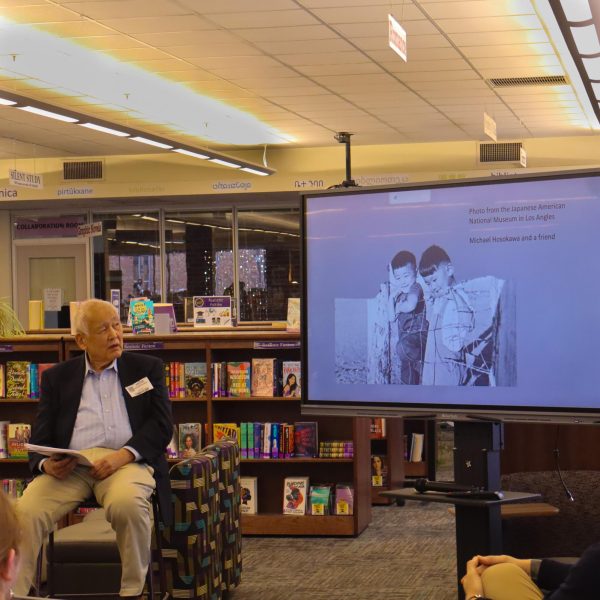
The event was organized to highlight what Rodeman’s APUSH students have been learning. While he does not want to tell kids what to think about the internment camps at that time or detention centers today, he does appreciate when they can use events like Hosokawa’s presentation to think critically.
“As a teacher, you just hope that with what you offer [students], through stories, through curriculum, that they do critically think… If people stop and think about that from Mike’s story, or go home and talk to their families or consider their own interpretations and understanding of current events through a history story from an individual, why wouldn’t I, as a teacher, want that?” Rodeman said.
Hosokawa’s story allowed the audience to see both past and present events through a more personalized lens.
“With everything that’s going on with ICE right now, like detention centers, it gives a lot more insight into how that actually feels. What it’s like to be taken away from your home and sent somewhere that you don’t know,” Ollie said.
While closing off his presentation, Hosokawa left the audience with some final advice for fighting against current governmental decisions.
“I don’t think it has to do with political parties. We’ve lost respect for people. We’ve lost our way. And I’m hoping you’ll find it. If this presentation excited you at all, then put your body where your mouth is, and above all, be kind to somebody,” he said.